
Everyone needs spiritual direction and Godly Counsel at some time in their lives. God did not make us to live totally isolated, independent lives one from another. God uses the analogy of sheep to describe us. Sheep are animals that need a lot of care. God is the Chief Shepherd, but He also appoints others under Himself to aid in the care of the flock.

There are specific situations where getting Godly Counsel is appropriate:
-
When you face major decisions such as marriage, career choice, and spiritual direction.
-
When you face crisis issues such as divorce, job loss, major or long-term illness, financial loss, the death of someone near, and physical, mental, emotional, verbal, and sexual abuse.
-
When you face unresolved conflicts such as in family relations, employer-employee relations, other social relations, church relations, and civil relations.
-
When you face addictions such as substance abuse (drug, alcohol, nicotine, and food), sexual addictions, work, ministry, or entertainment addictions, and fantasy addictions.
-
When you face uncontrolled negative emotions and thoughts such as fear, anger, jealousy, bitterness, hate, suicide, depression, doubt, and guilt.
-
When you have difficulties with sleep such as needing excessive amount of sleep, getting too little sleep, or having nightmares and excessive daydreams.
-
When you experience physical problems without a known physical cause.
-
When you become spiritually unsure or confused about your salvation from sin, your relationship with God, your spiritual future, or living a proper spiritual life.

Which Counselor?
We should begin by understanding that there are various levels of counseling:
First, there is the friendship level. If you have a minor problem, you may go to a close friend for advice. Second, there is the authority level. In certain situations you may seek the counsel of your parents, the boss, a pastor, a minister, civil or governmental authorities.
Third level is that of trained counselors. A trained counselor is someone who has specific training in the area of the problem that you are experiencing. God may work through all three of these levels.
There are also different general approaches to counseling. The sociologist will emphasize the importance of the influence of society as it molds the character of your life. The psychologist will emphasize the importance of "self" and the factors which influence "self-esteem". The psychiatrist will emphasize the importance of physical and chemical factors which influence your mental and emotional states. The biblical / pastoral counselor will emphasize importance of both the Living and the written Word of God and their influence upon your nature, character, and your inner life.

Effective Counseling
First, effective counseling is to be Jesus-centered. David declared, "Thou shalt guide me with thy counsel, and afterward receive me to glory" (Psalms 73:24). He also stated, "There is no wisdom nor understanding nor counsel against the LORD" (Proverbs 21:30). Therefore, in a general sense, all good Godly counseling must come from the LORD. Furthermore, the life, death, burial, resurrection, and ascension of Jesus must be the grounds for counsel. His life is our example. His death is our victory over sin. His resurrection is our assurance of new life. His ascension is our basis for victory over the enemy. The counselor's only hope in counseling is for the Spirit to intervene in the life of the counselee. When the Spirit of God intervenes, miracles occur, and God changes our lives.
Second, effective counseling is to be Scriptural. Paul tells us that the Word is the basis for doctrine, for reproof, for correction, and for instruction in right living (II Timothy 3:16). David said, "Thy testimonies also are my delight and my counsellors" (Psalms 119:24). The Bible is our instruction manual. It is our guide for life. Things go wrong when we fail to follow the manual. James declares that we are to receive the engrafted Word that is able to save our souls (mind, will, and emotions) (James 1:21).
Third, effective counseling is to be spiritually inspired. Solomon, in a dream, asked for wisdom, and God gave it to him (I Kings 3:9, 12). God also promises to give us wisdom. "If any of you lack wisdom, let him ask of God, that giveth to all [men] liberally, and upbraideth not; and it shall be given him" (James 1:5). Wisdom is the ability to see from God's perspective. However, one must not only see from God's perspective, one also must be able to communicate what God wants communicated. Therefore, one must be filled with the Holy Spirit. The counselor needs to be like Stephen. "And they were not able to resist the wisdom and the spirit by which he spake" (Acts 6:10). Good counseling should have Isaiah 11:2 as a motto.
Fourth, effective counseling should be discerning. The enemy may appear as an angel of light (II Corinthians 11:14). Therefore, the counselor should test the spirits (I John 4:1).
Fifth, effective counseling should be judged for accuracy. The Word says, "Where no counsel is, the people fall: but in the multitude of counsellors there is safety" (Proverbs 11:14). There should be no "Lone Rangers" in counseling. Most counselors have some blind spots that are seen by others, but not by themselves. The enemy also is more likely to attack the lone sheep. Those in counseling should be willing to submit to counseling themselves if needed.
Sixth, effective counseling is mature. We should heed the warning from Scripture. Rehoboam turned the people of Israel against him because " . . . he forsook the counsel which the old men gave him, and took counsel with the young men that were brought up with him, that stood before him" (II Chronicles 10:8). Mature counsel also knows when to feed milk and when to feed meat (I Corinthians 3:2 and Hebrews 5:12). Mature counsel has learned to discern between good and bad (Hebrews 5:14). Mature counsel is stable (Ephesians 4:13-14) and exemplifies the counsel of Christ. The result of spiritually mature counsel is that you learn the difference between what is right and what is wrong, repent, and receive freedom.
Seventh, effective counseling is progressive. God does not always answer us when we ask. "And Saul asked counsel of God, Shall I go down after the Philistines? wilt thou deliver them into the hand of Israel? But he answered him not that day" (I Samuel 14:37). Sin blocks the receiving of God-inspired counsel. Sin in your life also may block you from making progress. The counselor always desires that you make spiritual progress. However, when the counselor discovers a wall of resistance in your life, he may be unable to give the counsel that he would like to give until that wall is torn down. God may say, "Do what I have told you to do before I give you any more instructions." Christian counseling is to address the wall of resistance in love and with the authority of Grace.
Eighth, effective counseling is to be conviction based not naturally opinionated. My opinion is to be what God says in His Word, this takes time and maturity for an individual to have his opinions processed through the Cross of Christ and through God's Word. Paul said, "Preach the word; be instant in season, out of season; reprove, rebuke, exhort with all longsuffering and doctrine" (II Timothy 4:2). The primary reason that most people need counsel is that they, in some way, have not obeyed God or have not been taught to follow the Spirit. These are usually from independent effort to live by our own abilities in self-sufficiency and reject the grace of God, this to live off the mark and path of God's will. Therefore, one must come to see the roots of sin before he can get very far on the road to recovery.
Ninth, effective counseling needs to speak the truth in love. The truth will convince individuals in their minds and then cause a turning of their mind from one direction to another about the direction they are on. "For godly sorrow worketh repentance to salvation not to be repented of: but the sorrow of the world worketh death" (II Corinthians 7:10). Paul declared that he had a clear conscience before God and man (Acts 24:16). Once one receives a clear conscience, he can see clearly to make a stand. David said, "He shall not be afraid of evil tidings: his heart is fixed, trusting in the LORD" (Psalm 112:7). Paul declared, ". . . for I know whom I have believed, and am persuaded that he is able to keep that which I have committed unto him against that day" (II Timothy 1:12). He also exhorts us, "Therefore, my beloved brethren, be ye steadfast, unmoveable, always abounding in the work of the Lord, forasmuch as ye know that your labour is not in vain in the Lord" (I Corinthians 15:58).
Tenth, effective counseling must be prayer-centered. The Christian counselor will begin the session with prayer. When Christian counselors pray, God often brings to the surface the real issues. When Christian counselors pray, you receive deliverance, healing, and direction for your life. When you pray you may receive forgiveness for your sins, eternal life, and confidence that God will continue to work in your life.
Eleventh, effective counseling must deal with the whole person (spirit, soul, and body). We need to realize that each of these areas is interrelated. Moreover, when spiritual issues are dealt with, the other areas are dramatically effected. John wrote, "Beloved, I wish above all things that thou mayest prosper and be in health, even as thy soul prospereth" (III John 1:2). When you confess bitterness as sin and forgive the offender, then depression may leave and the symptoms of arthritis may also disappear. When you turn worry over to the Lord, then the confusion leaves and stomach trouble leaves.
The Whole Person Approach
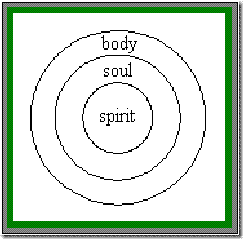
Where does Whole Person Counseling get its name? The Bible speaks of the whole person as being spirit, soul, and body (I Thessalonians 5:23). The spirit pertains to the spiritual part of man and involves a relationship with God and other spiritual beings. The soul pertains to the psychological and social aspects and involves the mind, will, and emotions. The body pertains to the physical part and involves the senses of hearing, seeing, smelling,, and tasting, and feeling. Whole Person Counseling is based upon the concept that these three parts of man (spirit, soul, and body) have a profound influence, one upon the other. What we believe and what we think has an enormous effect upon our mental and emotional stability, our physical health, our relationships with others, and our overall degree of success in life. Therefore, Whole Person Counseling looks at the relationship between each of the parts of man, recognizing that counseling must deal with the Whole Person in order to have a positive, lasting effect upon one's life. By God's grace you may set each part (spirit, soul, and body) in its proper order and achieve victory over many of life's most difficult problems.


